Law report No. GLW-1284 · filed November 15, 2026
Courts & TribunalsReported case
ICJ Election Reshapes Bench as ICC Splits Afghanistan Probe
Akande joins the ICJ as Latin America loses bench seats, the ICC splits its Afghanistan probe, and MINURSO's mandate expires in a pivotal fortnight for international law.
By Grace Kim5 min read1,011 words
Holding
- Dapo Akande was elected to the ICJ in November 2026; Latin America and the Caribbean hold one judge for the first time in Court history
- An ICC Pre-Trial Chamber ordered a separate investigation into crimes against women and girls in Afghanistan post-2021
- The UN Security Council failed to renew MINURSO's mandate in October 2026
- The ICJ will elect its President and Vice-President in February 2027
- EJIL's 2026 generative-AI policy faces criticism as conceptually unstable
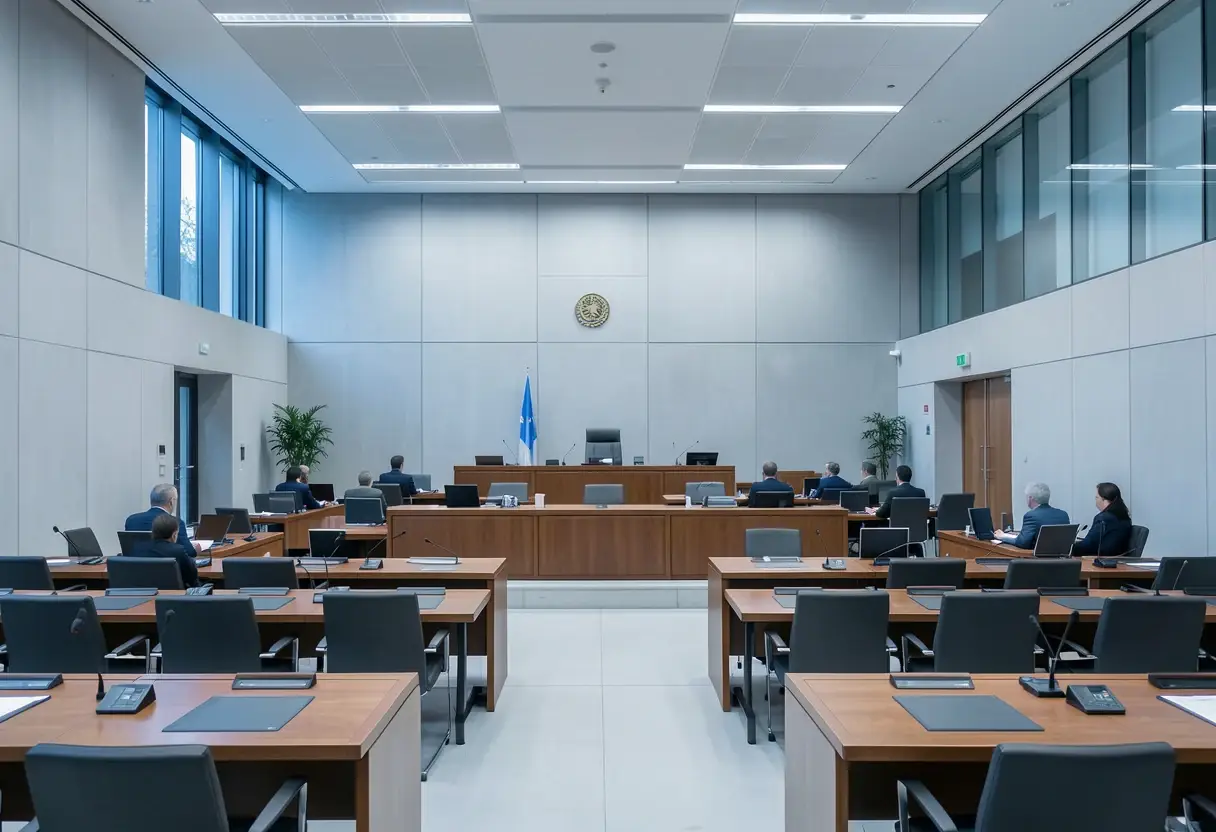
Dapo Akande's election to the International Court of Justice headline a fortnight that left Latin America and the Caribbean with a single ICJ judge for the first time in the Court's history. The developments of 2–13 November 2026 reached from The Hague to Western Sahara, where the UN Security Council let MINURSO's mandate lapse.
What did the ICJ elections change?
Marko Milanovic congratulated EJIL:Talk contributor Dapo Akande on his election to the ICJ, complete with an AI-generated video laudatio. Eric Chan shifted attention from who is in to who is out. The United Kingdom regained a seat, restoring representation of all five permanent Security Council members on the bench.
But the price was regional balance. Latin America and the Caribbean now hold only one judge for the first time since the Court's founding. Voting patterns in the General Assembly and Security Council expose the tension between three things:
- informal regional seat allocations;
- the privileged position of the P5;
- Article 9 of the ICJ Statute, which requires representation of the world's principal legal systems and forms of civilisation.
Chan raises a deeper question: whether entrenched patterns of representation reflect the diversity of international legal traditions, given the historical contributions and contemporary under-representation of the Global South.
Looking ahead, Noam Morris examined the February 2027 election of the ICJ's President and Vice-President. He distinguished the President's institutional and diplomatic responsibilities from procedural and judicial functions under Article 21 of the ICJ Statute and the Court's Rules. Seniority, re-election cycles, geographical representation and gender diversity all shape the choice historically. The takeaway: the Court's increasingly complex and politically sensitive docket makes judicial experience, administrative competence and diplomatic skill decisive criteria.
Did the ICC Pre-Trial Chamber overreach on Afghanistan?
Miles Jackson and Priya Urs criticised the ICC Pre-Trial Chamber's decision requiring a separate investigation into crimes committed against women and girls after the Taliban's return to power in 2021. The Chamber ordered this split despite existing arrest warrants issued within the Afghanistan situation.
The authors question the Chamber's reliance on inherent judicial oversight powers under Articles 15 and 53 of the Rome Statute. They argue the intervention lacks a clear statutory basis and contradicts the Appeals Chamber's approach to the scope of investigations. The result, they contend, is uncertainty over the validity and jurisdictional basis of existing warrants.
For practitioners, the stakes are structural. The decision risks undermining prosecutorial independence under Article 42, introducing procedural inconsistency and delaying justice for victims.
What happens to Palestinian nationality after recognition?
Eric Fripp argued that recognition of Palestinian statehood does not automatically confer Palestinian nationality. Palestinians without another nationality therefore remain stateless under Article 1(1) of the 1954 Convention relating to the Status of Stateless Persons.
The problem is concrete. In the absence of a Palestinian nationality law, States such as Norway and Sweden confuse statehood with citizenship when they treat Palestinians as nationals of Palestine following recognition. This risks depriving Palestinians of protections under the 1954 and 1961 Statelessness Conventions. It may also undermine rights under the 1951 Refugee Convention, whose refugee definition distinguishes between persons possessing a nationality and those who are stateless.
Is the global carbon budget reshaping climate litigation?
Rebecca Walker and Nolwen Guilleman examined the growing use of the global carbon budget in domestic climate litigation to test whether States are meeting their "fair share" of emissions reductions. Their focus fell on Bonaire v. Netherlands and earlier decisions including Urgenda and KlimaSeniorinnen.
Due diligence obligations under international climate law and human rights law increasingly require national mitigation targets to be quantified against the remaining global carbon budget. That calculation accounts for common but differentiated responsibilities, historical emissions and national capabilities. Courts have generally refrained from prescribing any particular allocation methodology. Even so, this jurisprudence supplies a more measurable standard of climate responsibility — one that does not require proof of a direct causal link between individual State emissions and particular environmental harm.
What did the Security Council do in Western Sahara?
Sebastian von Massow examined the Security Council's failure to renew MINURSO's mandate in October 2026. He warned that withdrawing UN observers will close the international community's eyes on an already isolated conflict, end important monitoring and demining activities, and potentially risk a shift in the conflict between Morocco and the Polisario Front.
The decision fits a longer trajectory. The Council has moved from implementing the Saharawi people's right to self-determination through a referendum towards promoting a negotiated settlement increasingly centred on Morocco's autonomy proposal. Von Massow argues this shift risks undermining the peremptory right to self-determination and the prohibition on territorial acquisition by force, with implications reaching well beyond Western Sahara.
How should IHL treat persons with disabilities?
Janet E. Lord assessed the ICRC's updated Commentary on the Fourth Geneva Convention and its engagement with the Convention on the Rights of Persons with Disabilities (CRPD). The Commentary's greater attention to disability is welcome. But persistent gaps remain: the conflation of disability with illness or incapacity, and insufficient consideration of Article 11 CRPD and Security Council Resolution 2475 (2019). Lord urged that the forthcoming Commentary on Additional Protocol integrate disability rights more systematically into IHL interpretation, particularly on humane treatment, medical care and civilian protection.
What is at stake in EJIL's AI policy?
Akira Kato criticised EJIL's 2026 generative-AI policy. The policy requires human intellectual contributions to clearly outweigh those of AI and relies on conventional academic co-authorship standards. Kato argued that iterative human–AI collaboration makes contributions difficult to disentangle, rendering the authorship threshold conceptually unstable and practically unenforceable — particularly given potentially severe consequences of non-compliance. He advocates absolute authorial accountability instead, under which human authors remain fully responsible regardless of AI involvement, while challenging mandatory disclosure and proposing peer review reforms that accommodate AI-assisted scholarship.
The fortnight's common thread is institutional strain: courts, councils and scholarly bodies are each testing where their authority ends.
via EJIL:Talk! (Source)
More from Grace Kim
Show full bio
Correspondent covering companies, deals and strategy in International law and legal practice at Global Law Wire.
320 articles
Also before the court
- Britain Returns to World Court as Dapo Akande Wins ICJ Seat
- UN Elects Five ICJ Judges, Two With Records in Israel-Linked Proceedings
- ICJ Finds UN Rights Council Made 'Significant but Limited' Progress
- ICJ Issues Landmark Climate Opinion: What It Means for States
- Saudi Envoy Calls ICJ Ruling a Historic Precedent