Law report No. GLW-9251 · filed November 6, 2026
Courts & TribunalsReported case
Supreme Court to Weigh DOL ALJ Fines in Sun Valley Orchards Case
The Supreme Court hears Department of Labor v. Sun Valley Orchards on Nov. 10, testing whether DOL administrative judges may impose fines without an Article III jury.
By Marcus Bennett4 min read723 words
Holding
- The Supreme Court hears argument in Department of Labor v. Sun Valley Orchards, LLC (No. 25-966) on Tuesday, Nov. 10.
- An August amicus brief supporting the employer was signed by former Attorneys General Edwin Meese III and Michael Mukasey and professor Gary Lawson.
- The 2024 decision SEC v. Jarkesy held that SEC civil penalties for securities fraud trigger a Seventh Amendment jury trial.
- The 1977 Atlas Roofing decision allowed OSHA enforcement orders without an Article III court or jury.
- Solicitor General D. John Sauer filed the government's briefs defending DOL administrative law judge authority.
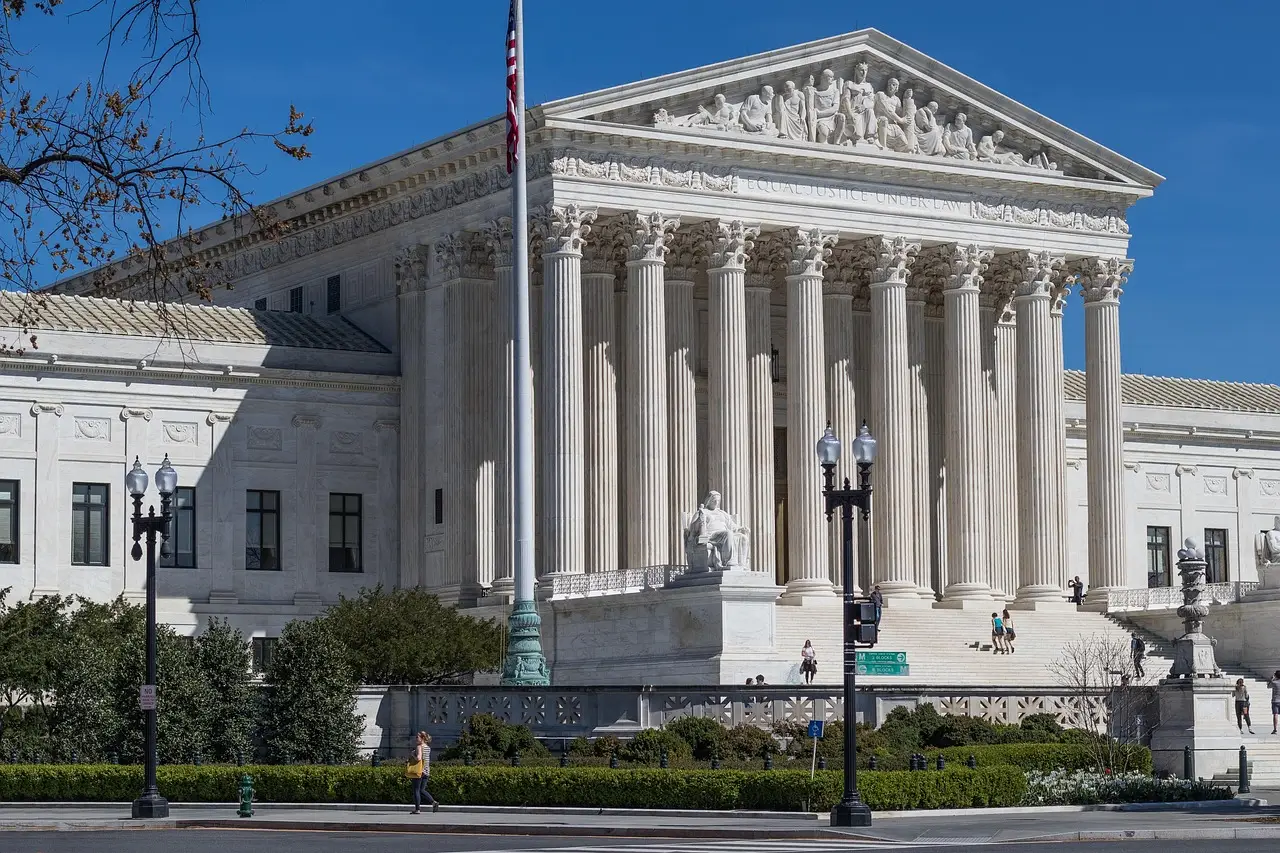
On Tuesday, Nov. 10, the Supreme Court will hear argument in Department of Labor v. Sun Valley Orchards, LLC, a case that asks whether the Department of Labor's administrative law judges may impose ruinous fines on employers accused of breaching contracts under the H-2A visa program for temporary foreign agricultural workers. The petition number is 25-966. At stake is whether such enforcement actions belong before an Article III court with a Seventh Amendment civil jury, or can stay within the agency's own tribunal.
The case arrives with heavyweight amicus support. In early August, an amicus brief was filed backing Sun Valley Orchards, signed by former Attorneys General Edwin Meese III and Michael Mukasey and law professor Gary Lawson, prepared and filed by lawyer Amit Vora. The brief argues that the employer is entitled not only to a Seventh Amendment civil jury but also to an Article III federal court.
Solicitor General D. John Sauer has filed the government's opening and reply briefs defending the DOL's authority. The government's core position is straightforward: it holds a sovereign right to control immigration into the United States, and the H-2A program flows from that power.
Why does the immigration argument fail, according to the amicus?
The amici concede the immigration point and then draw a line. The government can control admission of foreign workers, the brief's argument runs, but it cannot condition that admission on an American employer surrendering its constitutional right to have employment disputes adjudicated by Article III courts with a jury. Constitutional rights cannot be stripped without due process, the argument continues, whatever else the immigration power permits.
The framework relies on the Supreme Court's 1987 decision in Nollan v. California Coastal Commission. Justice Antonin Scalia wrote there that California could not use its zoning power to condition a construction permit on the owners granting a public easement across their coastal property, because that would violate the Fifth Amendment's takings clause. The same unconstitutional-conditions logic, the amici argue, bars the federal government from using its immigration power as a cudgel to extract waivers of Seventh Amendment rights.
What is the public-rights doctrine and how was it 'poisoned'?
Properly understood, the doctrine allows non-Article III judges to adjudicate government-created privileges — Social Security, disability or welfare payments, immigration itself, or tax rebates under a partial waiver of sovereign immunity. Those benefits were not property rights recognized at common law, so neither Article III nor the Seventh Amendment applies.
The 1977 decision in Atlas Roofing Co. v. Occupational Safety and Health Administration changed that, in the critics' view. Justice Byron White denied an Article III forum and a jury trial to a party subject to an OSHA enforcement order, reasoning that orders based on "new statutory obligations" could be "committed exclusively to an administrative agency [for] deciding whether a violation has in fact occurred." The critics answer that workplace torts are analogous to common-law actions — classic "Cases in Law" reserved by Article III to life-tenured judges.
What does Jarkesy change for ALJ enforcement?
The 2024 decision in SEC v. Jarkesy limited the damage. The Court held that when the SEC imposed civil penalties for securities fraud, the Seventh Amendment entitled the defendant to a jury trial, because fraud actions in 1787 would have been heard in courts of law. An employment contract dispute, on this reasoning, sits in the same category.
The lesson drawn for practitioners: ALJ rulings that merely allocate privileges require only an administrative hearing. But when a federal agency imposes ruinous fines on a person or corporation, those fines deprive the target of property — and property deprivations demand an Article III court with a civil jury available.
What should practitioners watch on Nov. 10?
The practical consequence cuts across every agency that uses in-house tribunals to levy monetary penalties. If the Court sides with Sun Valley, employers and other respondents facing agency fines gain a jury-trial entitlement and a route out of Article II adjudication. The broader question is doctrinal: whether the Court will formally cabin the public-rights doctrine to the rights-privileges distinction, as Jarkesy suggests, or leave Atlas Roofing's expansive reading standing as what one amicus calls a threat to Article III, the Seventh Amendment and the due process clause.
via supremecourt.gov (Original)
More from Marcus Bennett
Show full bio
Market editor covering regulation, policy and their impact on International law and legal practice at Global Law Wire.
264 articles
Also before the court
- Supreme Court to Test Article III Limits in H-2A Labor Dispute
- Supreme Court stays injunction blocking Big Bend border barriers
- Supreme Court Clears Trump Border Wall Construction in Texas Big Bend
- Supreme Court Takes Up Green Card Fight for Revoked Asylum Holders
- Cities Ask Supreme Court to Block Texas-DOJ Deal Killing Closure Rule